Sub-Projects
This work package ensures that all technologies developed within Renew4EHS are evaluated for their environmental and social impacts. It provides a unifying sustainability framework that spans all three technical projects. We conduct streamlined sustainability assessments of the renewable circuit‑board demonstrator, including SDG monitoring and identification of environmental and social hotspots.
For the energy‑harvesting systems (TENG and PENG), a full Life Cycle Assessment (LCA) is performed across relevant use cases, including end‑of‑life scenarios. These results are discussed with the consortium to highlight key sustainability levers. Similarly, the energy storage technologies developed in Project 3 undergo LCA analysis of sodium‑ion capacitors and their end‑of‑life pathways. Together, these activities ensure that Renew4EHS advances not only technological innovation but also robust environmental performance aligned with circular‑economy principles.
Comet Zentrum (K1)
„WOOD – transition to a sustainable bioeconomy“ wird im Rahmen von COMET – Competence Centers for Excellent Technologies – durch das BMK (Bundesministerium für Klimaschutz, Umwelt, Energie, Mobilität, Innovation und Technologie), BMAW (Bundesministerium für Arbeit und Wirtschaft) und den mitfinanzierenden Bundesländer Kärnten, Niederösterreich und Oberösterreich gefördert

Sub Projects
01 Renewable materials for sustainable electronics
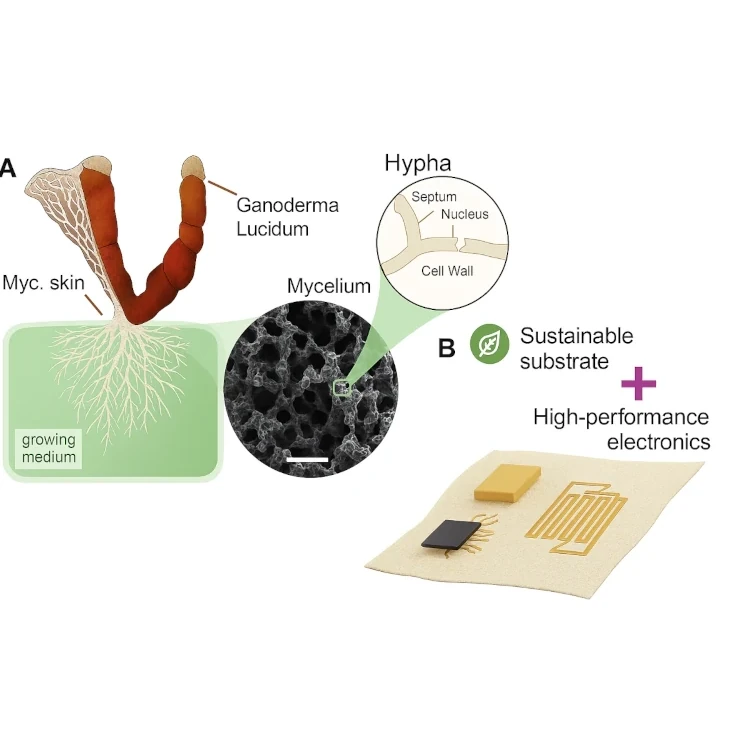
This project investigates how fungal mycelium, bacterial nanocellulose, and biomass‑derived carbon inks can be transformed into sustainable building blocks for future electronics. The developed materials will undergo comprehensive mechanical, electrical, and microscopic characterisation, followed by functionalisation and validation within flexible circuit structures. To demonstrate feasibility, the project will produce a prototype circuit board using bio‑adhesives and renewable substrates. In parallel, Life Cycle Assessment (LCA) and SDG evaluations will quantify the environmental benefits compared to conventional electronic systems.
02 Sustainable energy harvesting
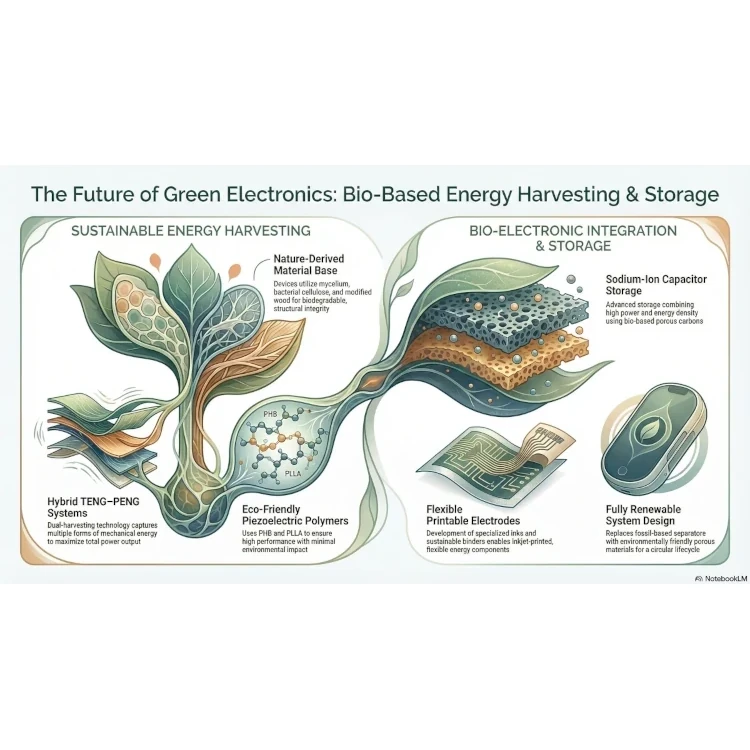
This project develops fully renewable energy-harvesting devices to enable self-powered electronics. We create biodegradable TENGs and sustainable PENGs using materials such as mycelium, bacterial cellulose, and modified wood structures. Through targeted material enhancements and structural optimisation, we improve efficiency, durability, and integration into flexible electronic systems. A key focus is the development of hybrid TENG–PENG systems, capturing multiple forms of mechanical energy to maximise power output. We also establish the foundation for direct coupling with sustainable energy storage solutions. The project investigates biodegradable polymers and composites (e.g., PHB, PLLA, polysaccharides) as next-generation piesoelectric materials, ensuring high performance with minimal environmental impact. Overall, Project 2 advances circular, recyclable, and eco-friendly energy-harvesting technologies for future green electronics.
03 Renewable materials for sustainable energy storage
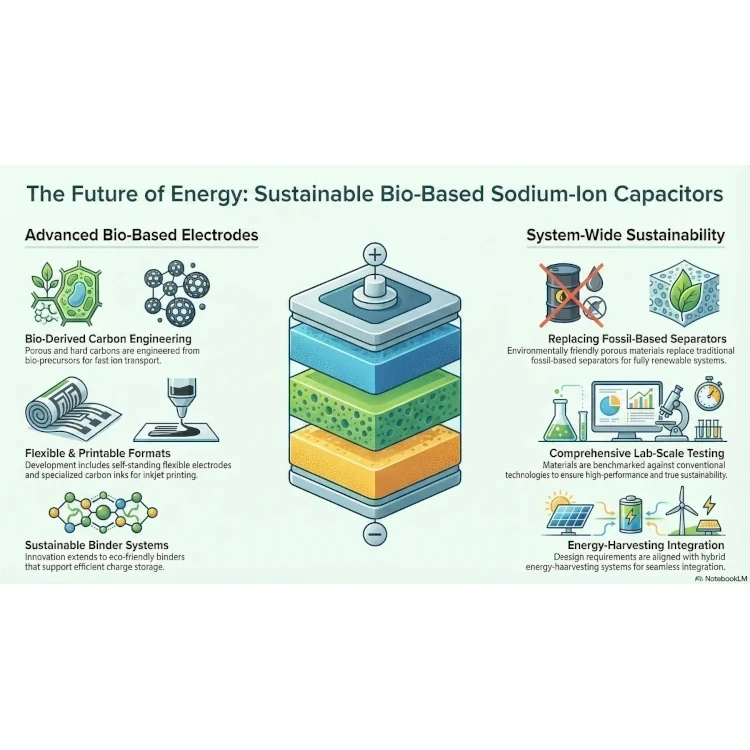
Project 3 develops next‑generation energy storage systems using renewable, bio‑based materials. The main focus is the creation of advanced sodium‑ion capacitors that combine high power and high energy density. To achieve this, we engineer innovative electrode – materialssuch as porous and hard carbons derived entirely from bio-based precursors and optimised for fast ion transport and efficient charge storage. The project produces both self‑standing flexible electrodes and printable carbon materials, supported by the development of specialised inks and sustainable binder systems. Early feasibility tests of inkjet-printed carbon electrodes will further support innovation in printed energy storage. Beyond electrodes, we design environmentally friendly porous materials to replace fossil‑based separators, enabling fully renewable capacitor systems. All materials undergo comprehensive characterisation and testing in lab-scale cells, with requirements aligned to hybrid energy-harvesting integration from Project 2. Through these advances, Project 3 delivers eco‑conscious, high‑performance energy storage solutions and benchmarks them against conventional technologies to ensure true sustainability.